


Anyone who has ever witnessed a total solar eclipse — or even a partial one — has been overawed and a little unsettled by the experience. Solar eclipses were one of the phenomena that prompted the ancient Greeks to study the stars and come up with the most brilliant astronomic discoveries of all time.
Let’s be honest, it’s never a good feeling to know that humans are not in charge and that our Sun’s precious rays can be obliterated in an instant, although we know full well that it is absolutely a temporary phenomenon.
It doesn’t take much imagination to think about how deep an impression eclipses made in the minds of those who went before us in time, who had no way of knowing the scientific ins and outs of the courses of the stars and planets — and who did not know that the sun indeed would ever emerge again.
But the patterns of eclipses set in motion the inner workings of the minds of some of the greatest men in scientific history, including ancient Greek astronomers; in the end, they were able to determine just why eclipses occurred and to dispel — at least to some extent — the unease that people felt whenever the moon blocked the sun.
Every time Earth experiences such an event, it is big news. It is for good reason that people converge en masse in areas which will be shadowed in an eclipse. The sight is a magnificent one, even to modern earthlings. A total solar eclipse, when the moon passes between the sun and the Earth, is a staggering event. For a few spellbinding minutes, day turns to night; the skies darken; the air instantly feels chillier. For those who look carefully and closely, stars can even appear in the sky.
Beyond awe-inspiring, solar eclipses often struck real fear in ancient peoples around the world, prompting their religious leaders and shamans to find reasons for the event, leading to scores of myths and rituals that were meant to shield their people from the evil that was thought to reign at that time of such unnatural darkness.
Astronomer and anthropologist Anthony Aveni, the author of “In the Shadow of the Moon: The Science, Magic, and Mystery of Solar Eclipses” tells Smithsonian Magazine “When anything extraordinary happens in nature … it stimulates a discussion about instability in the universe.”
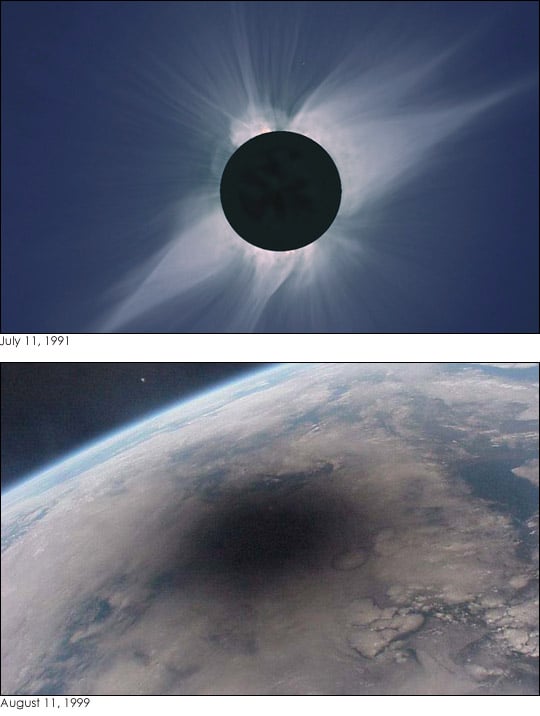
During a total solar eclipse, the Moon casts its shadow over the Earth when it moves in front of the Sun like the beam of a flashlight in reverse. Within this shadow — which measures about 100 miles across, according to NASA — day becomes night for a few minutes as the Sun’s disk turns black, surrounded by a glowing halo.
No one could think it surprising that there is a long history of prehistoric and ancient peoples cultures believing that eclipses were omens that portended significant — usually negative — events. The indescribable sense that our universe has been upended during these natural events inspired awe and fear, yes, but it also contributed to the formation of a scientific understanding of just how our universe works.
Ultimately, it laid the foundation for modern astronomy, with the brilliant contributions of the Ancient Greek astronomers.
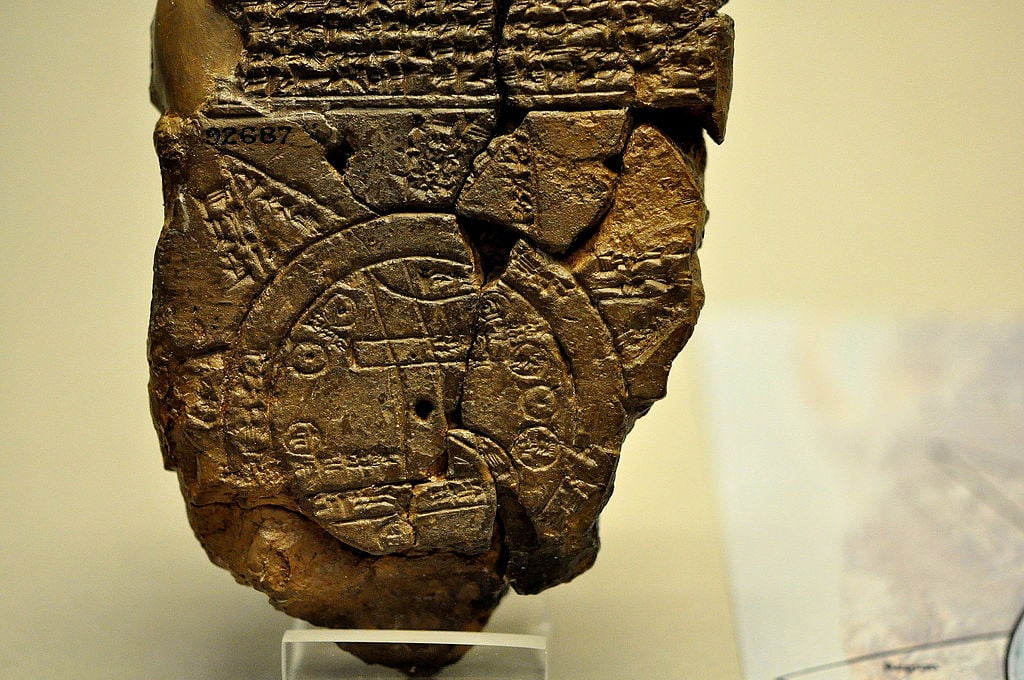
The ancient Babylonians were the first to record their efforts to make true scientific inroads into why the sun came to be darkened at these times.
A clay tablet inscribed in Babylonian from the first to third century BC shows a ritual that must be observed in the observances of eclipses. Part of the translated text reads: “That catastrophe, murder, rebellion, and the eclipse approach not… (the people of the land) shall cry aloud; for a lamentation they shall send up their cry.”
Because eclipses were considered by nearly all ancient peoples to be of grave significance, it was very important to learn if there was a pattern to them — and if so, how to predict them.
That meant keeping a close watch on the movements of the sun, moon and stars, writing down records of unusual celestial events and using them to create celestial calendars. From these first records, many peoples — including the Babylonians, Greeks, the Chinese, Mayas and others — began to discern patterns that could foretell when these disturbing events were set to recur.
Saros Cycle Detected by Babylonians, Encapsulated in Antikythera Mechanism
The Babylonians were among the first in the world to scientifically predict when a solar eclipse would indeed take place.
By the eighth century BC, Babylonian astronomers had been able to detect a pattern which was later dubbed the “Saros cycle.” This is a period of 6,585.3 days (18 years, 11 days, 8 hours) in which sets of eclipses repeat themselves.
John Dvorak, the author of the book “Mask of the Sun: The Science, History and Forgotten Lore of Eclipses,” notes that while the Saros cycle applies to both lunar and solar eclipses, it is likely that the Babylonians could only reliably predict lunar eclipses, which are visible to half of the Earth each time they happen, and thus are more easily studied.
Solar eclipses cast a relatively smaller shadow, as seen in the NASA image above, making it much less common to view such an event multiple times at any one place on Earth.
The Babylonian predictions, although accurate, were all based purely on observations, according to Dvorak; as far as scholars know now, their investigators never understood or perhaps even sought to understand the mechanism behind the motions of the planets. “It was all done on the basis of cycles,” he says.
Only in 1687, when Sir Isaac Newton published his theory of universal gravitation, which which drew heavily on the observations made by Greek astronomers, that we began to grasp the idea of complex planetary motions.
Aristarchus First Greek Astronomer to Posit Universe is Heliocentric
it was the ancient Greek astronomer Aristarchus who initiated the theory that the universe is heliocentric and that the planets are round — an essential understanding in any notion of an eclipse.
Although the Babylonians of Mesopotamia looked to the skies and postulated that the stars, the moon and the sun were gods that ruled over men. It was the ancient Greeks who took those theories of deities and turned them into mathematical equations and calculations.
One of the first people in the world to observe the moon scientifically, Aratus is so well known and respected by astronomers that when astronauts took the first step on the moon, the first crater they named was for Aratus.
Aratus was widely known during both the Hellenistic and Roman periods and his works on astronomy, as well as his poetry, are still read and studied to this day.
Often, Aratus combined astronomy with poetry, creating unique works that were extremely popular in his time. He is best known for his work “Phenomena,” a hexameter poem that describes the constellations.
Pythagorean Theorem and a Spherical Earth
Pythagoras of Samos, who lived from 570 to 495 BC, an ancient Greek astronomer and philosopher, was the eponymous founder of Pythagoreanism. Pythagoras was credited with many mathematical and scientific discoveries in antiquity.
In astronomy Pythagoras is credited with the belief that the earth is spherical and for identifying the morning and evening “stars” that we know today as the planet Venus. By the end of the fifth century BC, this fact was universally accepted among Greek intellectuals.
Ancient Greek Astronomer Aristarchus’ Heliocentric Model of the Universe
Aristarchus of Samos, who lived from 310 to c. 230 BC, was an ancient Greek astronomer and mathematician who presented the first known heliocentric model that placed the sun at the center of the known universe, with the earth revolving around the sun once a year and rotating about its axis once a day. Aristarchus identified the “central fire” with the sun. He put the other planets in their correct order of distance around the sun.
Aristarchus suspected that the stars were just other bodies like the sun, albeit farther away from earth. His astronomical ideas were, however, rejected in favor of the geocentric theories of Aristotle and Ptolemy.
Aristarchus estimated the sizes of the sun and moon as compared to the earth’s size. He also estimated the distances from the earth to the sun and moon, another key factor in how a solar eclipse is experienced on earth.
Ancient Greek Astronomer Eratosthenes Calculated Earth’s Circumference
Eratosthenes of Cyrene, who lived from 276 BC to 195 BC, was an ancient Greek astronomer who was also a multi-discipline scholar, or polymath. He was a mathematician, geographer, poet, astronomer and music theorist. He was a man of such learning that he also became the chief librarian at the Library of Alexandria.
Eratosthenes is best known for being the first person known to calculate the circumference of the earth, which he did by using the extensive survey results he could access in his role as the director of the Library of Alexandria. His calculation, a remarkably accurate one, is also pivotal in understanding how the shadow of the earth functions to create a lunar eclipse — another portentous event in prehistoric times.
Metonas the Mathemetician and Ancient Greek Astronomer
Metonas was a Greek mathematician, astronomer and engineer who lived in Athens in the 5th century BC. He is best known for the calculations he made for the Metonic cycle in 432 BC for the lunar calendar year of Attica.
Metonas’ calendar assumes that 19 solar years equals 235 lunar months, which equals 6,940 days. This system arose from calculations made by Metonas based on his own astronomical observations, which were confirmed by Aristarchus 152 years later.
According to the testimonies of ancient historians, Metonas installed the first Heliotropion, or Helioscope, a mechanism for observing the sun, in Pynx in Athens. The foundations of the Helioscope are incredibly still visible just behind the steps leading to Pnyx, the archaeological site perched on a small, rocky hill, just over 330 feet high in the center of Athens.
Antikythera Mechanism Calculates Solar Eclipses, Planetary Movement
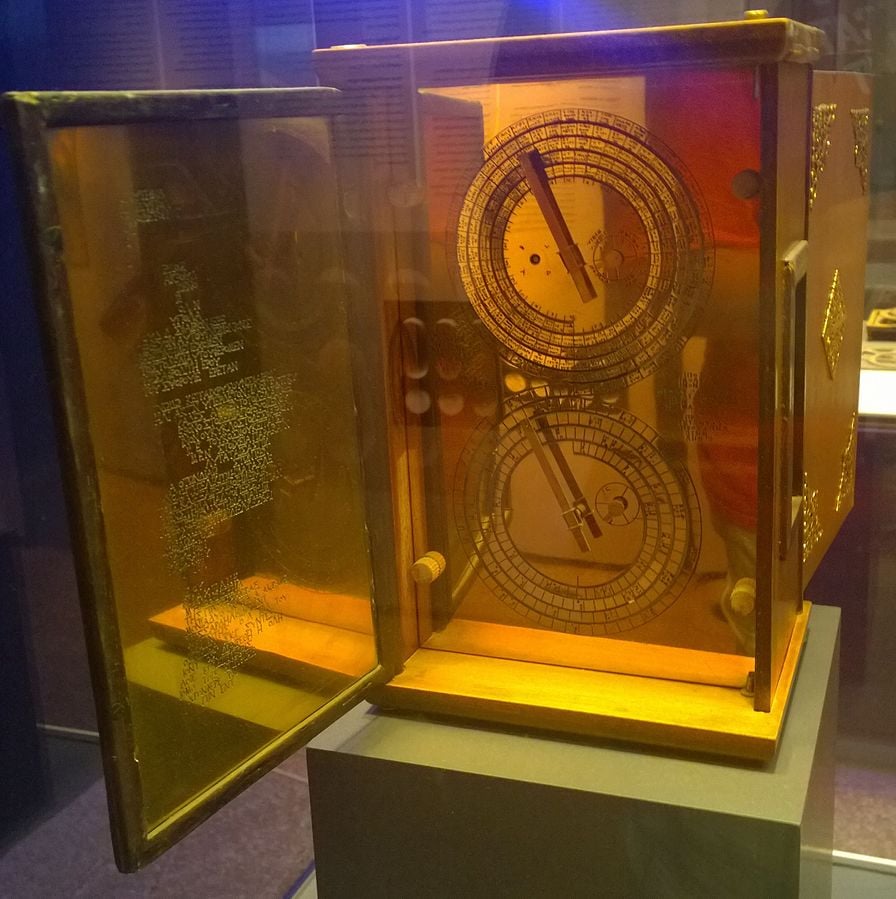
The Antikythera Mechanism, often referred to as the world’s first computer, was discovered inside an ancient shipwreck by Greek sponge divers on May 17, 1901. After numerous studies, it was estimated to have been constructed between 150 BC and 100 BC. A later study places it at 205 BC, just seven years after the death of the brilliant astronomer Archimedes.
It is concrete proof that the ancient Greeks not only understood how eclipses work — they even had a machine that would calculate when they would occur.
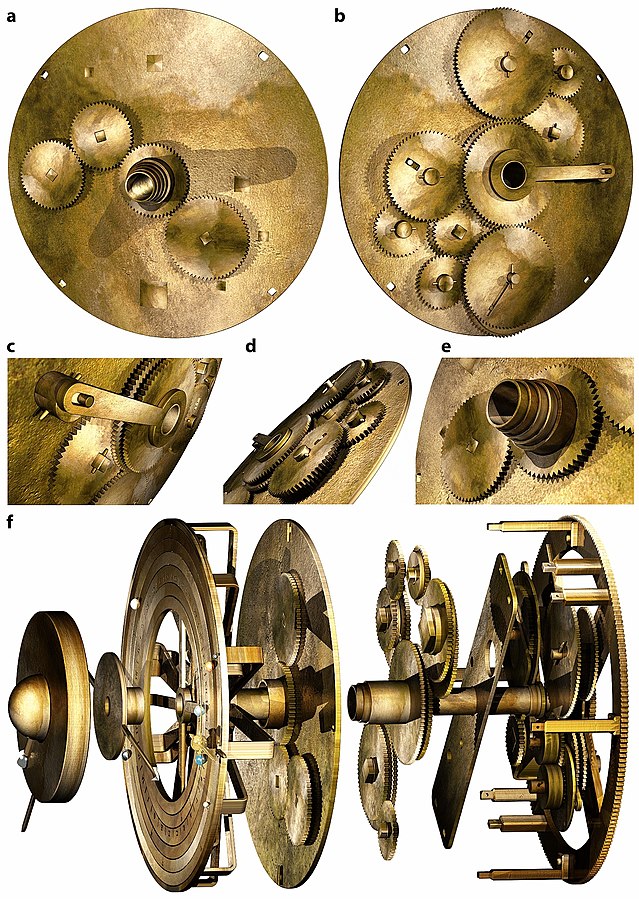
The world’s oldest surviving mechanical calculator, it was used by ancient Greek astronomers for solving a host of scientific dilemmas. The device has now been somewhat deteriorated by the passage of time, but when intact it would have appeared as a box, housing dozens of finely machined bronze gear wheels.
In 2005, it was established that it predicted eclipses, using the 223-lunar-month Saros Cycle from the 7th century BC that was created by the Babylonians. Understanding the complex eclipse prediction scheme on the Antikythera Mechanism has resulted from a fascinating series of discoveries.
The eclipse prediction is implemented through descriptive glyphs, inscribed round a 223-month “Saros Dial” at the rear of the Mechanism. A glyph in a particular month indicates a predicted eclipse.
When manually rotated by a handle, the gears spun dials on the exterior showing the phases of the moon, the timing of lunar and solar eclipses, and the positions of the five planets known then (Mercury, Venus, Mars, Jupiter, and Saturn) at different times of the year. This even accounted for their retrograde motion – an illusionary change in the movement of planets through the sky.
It may even have been the work of the great Archimedes himself, but there is no documentation of that, only speculation. Gearing technology with the sophistication of the Antikythera Mechanism was not seen again for one thousand years.
Of course, the ancient Babylonians weren’t trying to create the foundation of modern astronomy or mathematics as we know them today.
But in their tremendous efforts to understand celestial events and protect themselves against the evil that they believe solar eclipses portended, they began the scientific discovery that was perfected by the Greeks.
In giving the Greeks greatly-detailed records of the cosmos, they paved the way for the brilliant ancient Greek thinkers to prove once and for all — by calculations carried out by a machine — that indeed there were patterns to such natural phenomena, and thus they were not to be feared.
Astronomers today still use these extensive databases of ancient eclipses, originating in the time of ancient Babylon, to understand Earth’s movements throughout the ages.
So when we experience the otherworldly feeling that we surely will during the next eclipse, say a few words of thanks to the brilliant men of ancient Greece, who told us that there was nothing left to fear.
Comments
Post a Comment