
How Ancient Greeks Shaped the Latin Alphabet


Greeks latin alphabet
Greek inscription inside Saint Peter’s Basilica in Rome. Credit: Wikimedia Commons

The Latin alphabet is undoubtedly the world’s most recognizable form of written language, whose history goes back in time to the eras of ancient Greek and Roman dominance of the entire Western world.

In its modern form, with its many variations and alterations, the Latin alphabet is officially used by an amazing 131 sovereign nations, and it is also a co-official script form in twelve other countries.

Even in the countries which do not use it officially, most of their people not only recognize it, but they can also read it, mainly due to the global influence of the English language in our time.

However, the exact origins of the Latin alphabet now used by billions of people are relatively unknown, and very few people are actually aware that the Latin alphabet itself finds its roots in an older form of Greek writing.

The Origins of the Latin alphabet

It is widely accepted in the linguistic community that the Latin alphabet is a product of a long and complicated journey which ultimately has its roots back in the hieroglyphic tradition of ancient Egypt.

However, its most obvious and prominent influence derived from the Greek alphabet itself.
It was no other than the Euboean variation of the Greek alphabet, used on the island of Euboea (Evia) in Greece, which ultimately created what we now call the ”Western Greek alphabets.”

The western Greek alphabets shaped, in their turn, the Etruscan alphabet, the direct predecessor of the alphabet used by the Romans to write the Latin language.

The Euboean alphabet was used by the Greeks who lived in the cities of Chalkis and Eretria beginning in the early years of Greek antiquity.

The Greek Colony of Cumae and How it Shaped the Latin Alphabet
Greeks latin alphabet
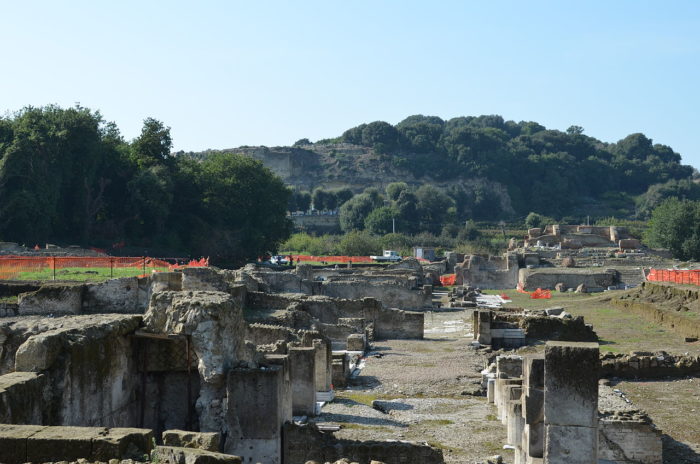
The Acropolis of Cumae as seen from the lower city. Photo credit: Wikipedia

The ancient Greeks of Chalkis were the first to make colonies on the mainland of today’s Italy.

As early as in the 8th century BC, Chalkideans sailed to Italy and established the first Greek colony on the peninsula, the city of Cumae (Κύμη).

In what is now an ancient site near the town of Cuma (whose name was derived from ancient Cumae) lies the secret of the creation of the alphabet which is currently used by most of humankind.

Cumae was not only the first colony the Greek settlers established, but it also became one of the most vibrant and powerful in the centuries before the Roman conquest.
Greeks latin alphabet
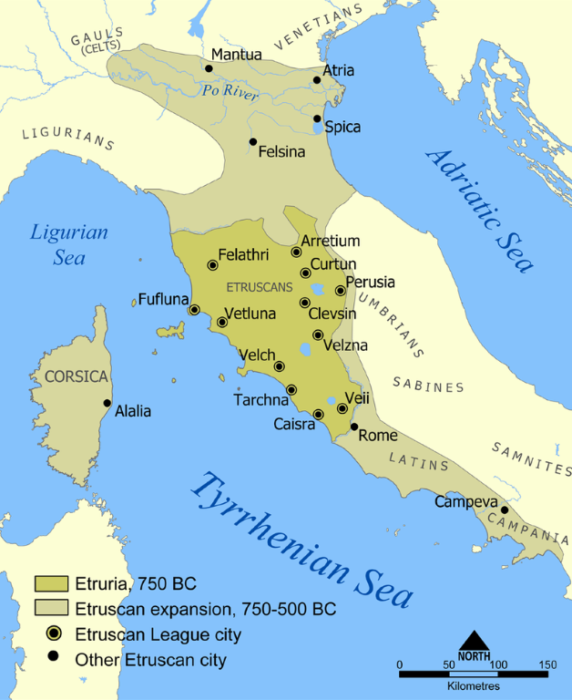
The boundaries of Etruscan civilization.

The Greeks of Cumae spread their Greek culture throughout Italy and introduced the Euboean alphabet, the one their ancestors were using on Euboea, Greece, to the local people.

The Etruscans, whose civilization came into direct contact and interrelation with the Greek settlers, were heavily influenced by Cumae and the rest of the nearby Greek settlements.

Thus, from approximately 650 BC up until around 100 BC, the Etruscans adopted and used the Euboean alphabet introduced to Italy by the Cumaean Greeks, to create a written form for their own, Etruscan language.

The meanings of most Etruscan words are still unknown today, comprising one of largest conundrums in the world of linguistics. Perhaps one day a Rosetta Stone enabling researchers to decipher the meanings of the Etruscan vocabulary will be found. However, the letters they adopted for the writing down of their language are perfectly recognizable.

The Etruscan Alphabet

Greeks latin alphabet
Restoration of the Etruscan script found on Nestor’s Cup, an eighth-century BC wine cup discovered in 1954 on the island of Pithekoussai, today’s Ischia in Italy. The text was written from right to left.

The alphabet adopted by the Etruscans was almost identical to Euboean Greek, which in its turn, was very similar to the Greek alphabets used at that time in ancient Greece. However, it did have some differences both in terms of its phonetics and in the shape of its letters.

By simplifying things a bit, we could say that the appearance of the Euboean, and consequently the Etruscan alphabets, that could be described as a mixture of what we know today as the Greek and Latin alphabets.

The Etruscans, of course, added their own elements, shaping the Euboean alphabet in a way that would suit their own language, thus creating the precursor of the alphabet the Romans would eventually use.

For example, while most of the Greek alphabets used the letter ”Π” to depict the sound of ”p,” the Etruscans wrote that letter in a way that was closer to today’s shape of ”P,” paving the way for the formation of what we know today as ”P” and ”p” in English.

The same happened with other ancient Greek letters, such as the letter sigma depicted as ”Σ,” which was written by the Etruscans in a way that was closer to today’s ”S” rather than the Greek ”Σ”.

The Latin Alphabet as a Variation of the Etruscan

Latin inscription in the Colosseum of Rome
Latin inscription in the Colosseum of Rome, Italy. Photo credit: Wikipedia

Following centuries of becoming more and more instrumental in Italy’s cultural development, the Etruscan alphabet became the father of the Latin alphabet itself.

The Romans, along with their complete conquest of the Italian peninsula, adopted the Etruscan alphabet to use it as a written form of their own, Latin language, which soon became the lingua franca of Italy, eclipsing the Etruscan language and other dialects.
These other languages would eventually become completely extinct.

The Romans, of course, shaped the Etruscan alphabet in a way that would suit their own Latin language’s needs. For this reason, they reshaped some of their letters and introduced new ones over the passage of time while abolishing others.

The Romans kept letters which originally belonged to the Greek alphabet, but were later abolished by the Greeks, such as the letter ”F,” which was originally known as ”digamma.”

The Romans did not hesitate to introduce new letters to their alphabet as well, as soon as they were heavily influenced by the rich culture of Greece following the Roman conquest of Greece.

Prominent examples of this influence include the letters ”Y” and ”Z,” which did not exist in the Latin alphabet until the Romans realized that they needed them to transliterate Greek words that their language was adopting.

Not simply a variation of the Greek

It is obvious that without the first Greek colonies of Italy and their massive cultural influence in the region, today’s world of the written word might have been completely different.

However, one must never perceive the evolution of languages as a static and unique process in any way.

Linguistic influences, adaptations and alterations take centuries to create a wholly ”new product” in the form of an alphabet or a language; thus one cannot simply say that the Latin alphabet is simply a variation of the Greek.

We should all bear in mind that the Greek alphabet itself, a form of written text that shaped Latin so profoundly, was itself nothing more than a product of the evolution of the Phoenician alphabet, which in its turn, finds its roots in the hieroglyphics of ancient Egypt.

The journey of any alphabet or language is far more complicated than we could ever even imagine, leaving us plenty of room for deep scientific research which can unveil the truth behind one of humanity’s most basic needs: to speak and write to forge a connection with others.

Comments

Popular Posts

Μπέος: «Εύστοχα χαρακτηρίστηκε φτύσιμο στα μούτρα των μελών της ΕΕΑ»

Καρφιά προς την Επιτροπή Επαγγελματικού Αθλητισμού έριξε με δήλωσή του στα social media ο Αχιλλέας Μπέος. Με αφορμή την απόφαση του CAS για την υπόθεση ΠΑΟΚ-Ξάνθης, ο δήμαρχος Βόλου θυμήθηκε τις ενέργειες της επιτροπής στην περίπτωση του Ολυμπιακού Βόλου το 2011 όταν εκείνος ήταν ο ισχυρός άνδρας της ομάδας. Επίσης εξέφρασε την απορία του για το ότι κανείς μέχρι σήμερα δεν έχει υποβάλλει την παραίτησή του. Αναλυτικά όσα έγραψε ο Αχιλλέας Μπέος: «Η απόφαση του Διεθνούς Αθλητικού Δικαστηρίου (CAS) για την υπόθεση των ΠΑΟΚ–Ξάνθης, αναμφίβολα είναι ένα ηχηρό χαστούκι γι αυτό που στην Ελλάδα ονομάζουμε Επιτροπή Επαγγελματικού Αθλητισμού, που υποτίθεται αξιολογεί, κρίνει και αποφασίζει αντικειμενικά και με βάση το ισχύον Δίκαιο και στην πραγματικότητα αποδεικνύεται ένα εργαλείο άσκησης μικροπολιτικής και ικανοποίησης αθέμιτων επιθυμιών και επιδ...

The Fascinating History of Thessaloniki’s Iconic White Tower

The White Tower. Credit: ΣΟΛΑΚΙΔΗΣ ΣΩΤΗΡΙΟΣ /Wikimedia Commons/ CC BY-SA 4.0 Residents of Thessaloniki, Greece’s second largest city, often use its White Tower as a point of reference when giving directions in the beautiful seaside city. That’s because the tower is by far Thessaloniki’s most iconic monument. The ancient city, located in northern Greece, has a rich history stretching from antiquity to the modern era, but is most noted for its importance during the Byzantine period. During that time, Thessaloniki was a competitor with the great city of Constantinople in terms of its wealth and influence. The White Tower was a witness to many of the city’s most important historical events, and its role in Thessaloniki changed as did the ownership of the city itself throughout the millennia. Studying the history of the White Tower means learning the history of Thessaloniki. The Tower’s strategic location along the Thermaic Gulf made it perfect for guarding the city from thre...

Άποψη ΚΥΡ


Inside the Magnificent Minoan Palace of Knossos in Crete

The Minoan palace at Knossos. Credit: Gary Bembridge /Wikimedia Commons/ CC-BY-2.0 The Palace of Knossos, located about five kilometers (three miles) south of Heraklion on Kephala hill, was the largest of all the Minoan palaces in Crete. It was also at the core of the highly sophisticated civilization that flourished on the island over 3,500 years ago. The discovery of the Minoan Palace of Knossos The discovery and subsequent excavation of the palace dates back to the beginning of the twentieth century. Before then, Knossos had only served as a place mentioned in Greek mythology. The first modern scholar to take a serious interest in the area was the German Heinrich Schliemann, who in 1870 had excavated the site believed to be Troy. Schliemann was certain that a major Minoan palace lay hidden near Heraklion, but the Ottoman authorities who still ruled the island at the time denied any permission to dig there. Years afterward, the British archaeologist Arthur Evans, inspired b...

Άποψη Κ Μητρόπουλου

 Άποψη

Βίκυ Κάβουρα: Τι απαντά στις φήμες επανασύνδεσης με τον Νίκο Οικονομόπουλο;

  Τη δική της απάντηση στις φήμες και τα δημοσιεύματα που υπήρξαν τις τελευταίες μέρες και έκαναν λόγο για επανασύνδεση με τον Νίκο Οικονομόπουλο έδωσε η Βίκυ Κάβουρα. Η γνωστή ηθοποιός ξεκαθάρισε στη RealLife: «Δεν ισχύει η επανασύνδεση. Δεν συνηθίζω να επιστρέφω σε κάτι παλιό». Η Βίκυ Κάβουρα είχε σχέση με τον γνωστό τραγουδιστή για 1,5 περίπου χρόνο και έληξε το 2015. «Αυτή την περίοδο με απασχολεί περισσότερο ότι έχει να κάνει με την υγεία. Πρόσφατα πέρασα μια περιπέτεια με τον πατέρα μου. Αντιμετώπισε ένα θέμα, αλλά ευτυχώς τώρα όλα είναι καλά. Αυτό είναι το μόνο που μπορεί να με ρίξει» συμπλήρωσε η Βίκυ Κάβουρα. Η ηθοποιός ρωτήθηκε και για τις καταγγελίες ανδρών και γυναικών για λεκτική, σωματική βία, αλλά και σεξουαλική παρενόχληση και κακοποίηση στον χώρο του θεάτρου. «Με πολύ στενοχώρια το παρακολουθώ. Εγώ δεν έχω υποστεί κάποια παρενόχληση, αλλά θέλω να σταματήσουν αυτές οι συμπεριφορές. Θέλω έναν άλλο κόσμο που ο...
  Ξέφυγαν εντελώς οι Τούρκοι απόστρατοι -Ονειρεύονται απόβαση σε ελληνικά νησιά Ο ναύαρχος ε.α. του τουρκικού Ναυτικού Τζιχάτ Γιαϊτζί, γνωστότερος ως εμπνευστής του παράνομου τουρκολιβυκού μνημονίου για την ΑΟΖ, δήλωσε, ότι χάρη στην συμφωνία αυτή η Λιβύη πήρε τέσσερα νησιά από την Ελλάδα και δεκάδες τ.χλμ. θαλάσσιων εκτάσεων, χωρίς όμως να αναφέρει ποια νησιά ήταν αυτά που αποκάλεσε μεν ελληνικά, αλλά τώρα είναι… λιβυκά! Ο Γιαϊτζί, γνωστός «μαϊντανός» των τουρκικών ΜΜΕ «εξήγησε», κατά τη διάρκεια συνέντευξής του στο κανάλι Al-Jazeera Mubasher, ότι «αυτή η συμφωνία παρείχε στη Λιβύη "39 χιλιάδες χιλιόμετρα υδάτινης επιφάνειας, μαζί με 4 ελληνικά νησιά"», προσθέτοντας ότι «εάν η Λιβύη είχε υπογράψει τη συμφωνία...

Επτά ψηφιακές υπηρεσίες αποκλειστικά για συνταξιούχους από τον e-ΕΦΚΑ

Επτά σύγχρονες υπηρεσίες αποκλειστικά για συνταξιούχους παρέχονται πλέον ηλεκτρονικά από τον Εθνικό Φορέα Κοινωνικής Ασφάλισης (e-ΕΦΚΑ), στο πλαίσιο της στρατηγικής του να βελτιώσει σημαντικά το επίπεδο εξυπηρέτησης των πολιτών και ειδικότερα των ατόμων της τρίτης ηλικίας. Όπως επισημαίνει ο e-ΕΦΚΑ, «αυτές οι υπηρεσίες προσφέρουν άμεση διεκπεραίωση ενός αιτήματος, ταχύτητα στην υποβολή των αιτήσεων και 24ωρη ενημέρωση για θέματα που αφορούν τους υποψήφιους ή εν ενεργεία συνταξιούχους. Αντικαθιστούν επίσης γραφειοκρατικές διαδικασίες, που με τη σειρά τους προκαλούσαν ταλαιπωρία και καθυστερήσεις στην υλοποίηση των συναλλαγών με το φορέα. Αν ληφθεί υπόψιν και η διαρκώς αυξανόμενη χρήση τους, φαίνεται πως οι απόμαχοι της δουλειάς, αλλά όχι απόστρατοι της κοινωνικής συμμετοχής και δράσης, κατακτούν σταδιακά και το πεδίο των νέων τεχνολογιών» αναφέρει χαρακτηριστικά. Επιδίωξη του e-ΕΦΚΑ, από την έναρξη της υγειονομικής κρίσης, όπως σημειώνει, υπήρξε η προ...

Απειλεί με αντίποινα η Τουρκία

7 Η δήλωση του προέδρου των ΗΠΑ Τζο Μπάιντεν ότι οι σφαγές των Αρμενίων κατά την Οθωμανική Αυτοκρατορία συνιστούν γενοκτονία είναι "απλά εξωφρενική" και η Τουρκία θα απαντήσει με διάφορους τρόπους τους επόμενους μήνες, δήλωσε σήμερα ο εκπρόσωπος της τουρκικής προεδρίας. Ο Τζο Μπάιντεν παρέκαμψε την επί δεκαετίες προσεκτικά βαθμονομημένη γλώσσα του Λευκού Οίκου για τις σφαγές του 1915, ικανοποιώντας την Αρμενία και τη διασπορά της στις Ηνωμένες Πολιτείες, αλλά επιτείνοντας περαιτέρω τις εντάσεις στις σχέσεις μεταξύ της Ουάσινγκτον και της Άγκυρας, δύο συμμάχων του ΝΑΤΟ. "Θα υπάρξει αντίδραση διαφορετικής μορφής και είδους και βαθμού τις επόμενες ημέρες και μήνες", δήλωσε ο Ιμπραήμ Καλίν, ο εκπρόσωπος και σύμβουλος του προέδρου Ταγίπ Ερντογάν σε συνέντευξη που παραχώρησε στο Reuters. Ο Καλίν δεν διευκρίνισε εάν η Άγκυρα θα περιορίσει την πρόσβαση των ΗΠΑ στην αεροπορική βάση του Ιντσιρλίκ στη ...

Θεσσαλονίκη: Εκατοντάδες μερίδες φαγητού σε αστέγους από τοπική επιχείρηση εστίασης

Στη Θεσσαλονίκη, μια επιχείρηση εστίασης αποδεικνύει εμπράκτως τι σημαίνει ευαισθησία και κοινωνική ευθύνη. Πρόκειται για το εστιατόριο του Στέφανου Σαράτση που έχει αρχίσει αυτή την προσπάθεια τους τελευταίους δύσκολους μήνες. Συμπαραστάτες του γνωστοί και άγνωστοι πολίτες που βοηθούν όσο μπορούν.

Airline Training Center

Car 'n Motion

Αthletix.gr

Φόρμα επικοινωνίας

Name

Email *

Message *