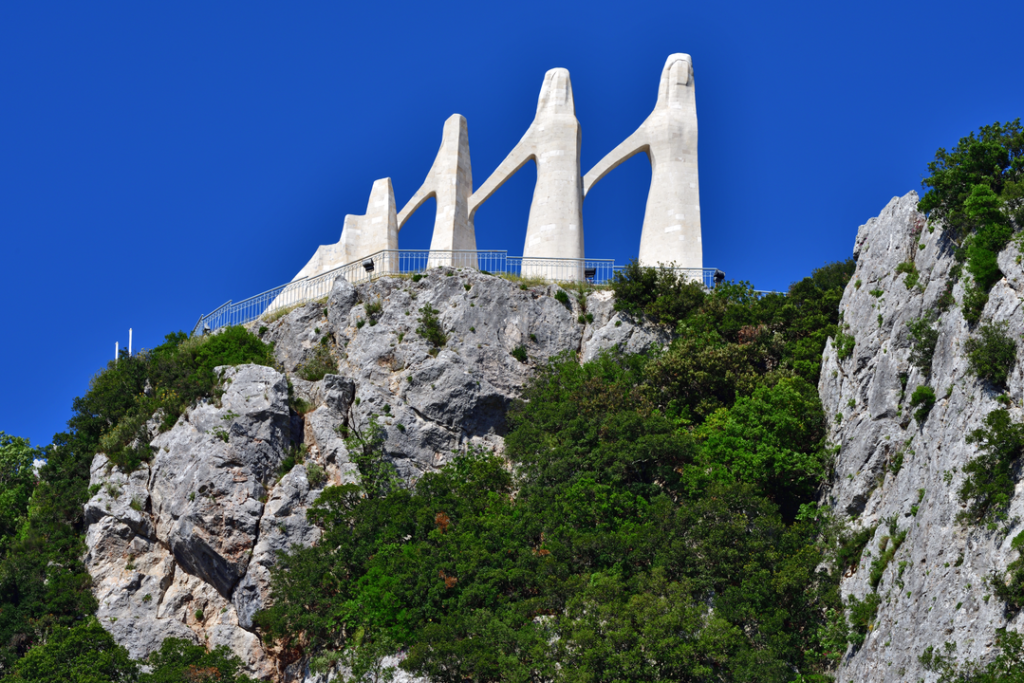
Zalongo Monument: Site of Cultural Heritage Marks Sacrifice of Greek Women


Zalongo monument Greece cultural heritage site
The Zalongo Monument has been named a site of Modern Cultural Heritage in Greece. Credit: HaTe/Wikimedia Commons/CC BY-SA 4.0

The Zalongo Monument, located in Epirus, northwestern Greece, was named a site of Modern Cultural Heritage by the Ministry of Culture this month to celebrate the monument’s 60th anniversary.

Zalongo Monument now site of Modern Cultural Heritage

The monument, which was unveiled in 1961 was designed by George Zongolopoulos to commemorate the mass suicide of women and children which occurred in 1803, called the “Dance of Zalongo.” The moving monument took six years to construct, from 1954 to 1960.

The monument itself is 13 meters (42 feet) high, almost the same height as a five story building. The sculpture/monument has been hailed the as the sculptor’s greatest lifework and continues to be relevant to this day.

In order to build the project, Zongolopoulos needed to jump through multiple hoops and innovate ad hoc to overcome issues surrounding getting heavy concrete up to the 700 meter (2,296 foot) summit of Mount Zalongo.

The interior of the sculpture is made of concrete, while the outer shell was constructed using 4,300 off-white limestone blocks which were mined from a quarry 160 kilometers from the monument’s construction site. The materials were transported in larger pieces before being cut down to 50x25x20 cm blocks once they were at the site of the future monument.

At the beginning of the project, Zongolopoulos built a lift to transport materials up the mountain, but safety concerns meant that this mechanism was replaced by more old-school human — and animal — labor.

George Zongolopoulos Foundation campaigns for recognition

The George Zongolopoulos Foundation, established in 2004, works to preserve and represent Zongolopoulos’ famous sculptures. Top of the priority list when it was founded was to make sure that the Zalongo Monument, commemorating the heroic actions of the women of the city just prior to the War of Independence, was being preserved and cared for properly.

Over the course of three years, and with the assistance of the Municipality of Zalongos and the Epirus Regional Authority, funds were collected to help fund a restoration project, which was completed five years later by Angelos Moretis.

The newest move involving the recognizing the monument as a cultural heritage site in Greece was actually also engineered by the Foundation, which petitioned to have it listed in August of 2020.

“It is a vindication for this great Greek artist, as well as a recognition of the monument’s artistic merit,” announced the president of the George Zongolopoulos Foundation, Nicos Theodoridis, when he heard of the Ministry’s decision.

It is clear the breathtaking monument deserves this status, as despite its difficult position, 30,000 to 35,000 people visit it a year. The numbers of people who climb the  410-step footpath, designed by Patroklos Karantinos, to view the Monument shows the influence and beauty of the sculpture.

The current goal of the foundation is to get a cable car built up to the site of the Monument.

Comments

Popular Posts

Μπέος: «Εύστοχα χαρακτηρίστηκε φτύσιμο στα μούτρα των μελών της ΕΕΑ»

Καρφιά προς την Επιτροπή Επαγγελματικού Αθλητισμού έριξε με δήλωσή του στα social media ο Αχιλλέας Μπέος. Με αφορμή την απόφαση του CAS για την υπόθεση ΠΑΟΚ-Ξάνθης, ο δήμαρχος Βόλου θυμήθηκε τις ενέργειες της επιτροπής στην περίπτωση του Ολυμπιακού Βόλου το 2011 όταν εκείνος ήταν ο ισχυρός άνδρας της ομάδας. Επίσης εξέφρασε την απορία του για το ότι κανείς μέχρι σήμερα δεν έχει υποβάλλει την παραίτησή του. Αναλυτικά όσα έγραψε ο Αχιλλέας Μπέος: «Η απόφαση του Διεθνούς Αθλητικού Δικαστηρίου (CAS) για την υπόθεση των ΠΑΟΚ–Ξάνθης, αναμφίβολα είναι ένα ηχηρό χαστούκι γι αυτό που στην Ελλάδα ονομάζουμε Επιτροπή Επαγγελματικού Αθλητισμού, που υποτίθεται αξιολογεί, κρίνει και αποφασίζει αντικειμενικά και με βάση το ισχύον Δίκαιο και στην πραγματικότητα αποδεικνύεται ένα εργαλείο άσκησης μικροπολιτικής και ικανοποίησης αθέμιτων επιθυμιών και επιδ...

The Fascinating History of Thessaloniki’s Iconic White Tower

The White Tower. Credit: ΣΟΛΑΚΙΔΗΣ ΣΩΤΗΡΙΟΣ /Wikimedia Commons/ CC BY-SA 4.0 Residents of Thessaloniki, Greece’s second largest city, often use its White Tower as a point of reference when giving directions in the beautiful seaside city. That’s because the tower is by far Thessaloniki’s most iconic monument. The ancient city, located in northern Greece, has a rich history stretching from antiquity to the modern era, but is most noted for its importance during the Byzantine period. During that time, Thessaloniki was a competitor with the great city of Constantinople in terms of its wealth and influence. The White Tower was a witness to many of the city’s most important historical events, and its role in Thessaloniki changed as did the ownership of the city itself throughout the millennia. Studying the history of the White Tower means learning the history of Thessaloniki. The Tower’s strategic location along the Thermaic Gulf made it perfect for guarding the city from thre...

Ten Unforgettable Things to Do Around Syntagma Square in Athens

  Syntagma Square, Athens. Credit: Public Domain Syntagma Square has literally been the very heart of Athens ever since the city became the capital of the modern Greek state. With the Greek Parliament building and the Tomb of the Unknown Soldier looming over it, it is rich with history and is the place where most major events of the last two centuries have taken place. Its name in Greek means “Constitution Square,” a name granted by Greece’s first modern royal, King Otto, on September 3, 1843, after an uprising of the people. This was a smart political move, since the royal palace overlooked the square. In 1934, the royal palace was turned over to the Greek Parliament, and ever since that time, Syntagma Square has been the place where all public protests and demonstrations have taken place. Syntagma Square home to historic demonstrations and protests In December of 1944, just after the departure of the occupying Nazi troops, a people’s rally at the square was marred b...

Inside the Magnificent Minoan Palace of Knossos in Crete

The Minoan palace at Knossos. Credit: Gary Bembridge /Wikimedia Commons/ CC-BY-2.0 The Palace of Knossos, located about five kilometers (three miles) south of Heraklion on Kephala hill, was the largest of all the Minoan palaces in Crete. It was also at the core of the highly sophisticated civilization that flourished on the island over 3,500 years ago. The discovery of the Minoan Palace of Knossos The discovery and subsequent excavation of the palace dates back to the beginning of the twentieth century. Before then, Knossos had only served as a place mentioned in Greek mythology. The first modern scholar to take a serious interest in the area was the German Heinrich Schliemann, who in 1870 had excavated the site believed to be Troy. Schliemann was certain that a major Minoan palace lay hidden near Heraklion, but the Ottoman authorities who still ruled the island at the time denied any permission to dig there. Years afterward, the British archaeologist Arthur Evans, inspired b...

Άποψη ΚΥΡ


Άποψη Κ Μητρόπουλου

 Άποψη

Θεσσαλονίκη: Εκατοντάδες μερίδες φαγητού σε αστέγους από τοπική επιχείρηση εστίασης

Στη Θεσσαλονίκη, μια επιχείρηση εστίασης αποδεικνύει εμπράκτως τι σημαίνει ευαισθησία και κοινωνική ευθύνη. Πρόκειται για το εστιατόριο του Στέφανου Σαράτση που έχει αρχίσει αυτή την προσπάθεια τους τελευταίους δύσκολους μήνες. Συμπαραστάτες του γνωστοί και άγνωστοι πολίτες που βοηθούν όσο μπορούν.

Άποψη


Άποψη


The World’s Oldest Living Olive Tree is on Crete

The most ancient olive tree in the world, in Crete. Credit: Dimitra Damian/Greek Reporter The oldest olive tree in the world is located in the village of Ano Vouves of Kissamos in Chania, Crete. The ancient tree is 3000 years old, as determined by the international scientific community. The ancient olive tree in Vouves has a trunk with a circumference of 12.5 meters (41 feet), and a diameter of 4.6 meters (15 feet). It belongs to the local tree variety of tsounati, and was grafted at a height of 3 meters onto a wild olive tree. Because of the grafting, its trunk has been so beautifully shaped by nature that it resembles a sculpture. In 1990, after a unanimous decision in the prefecture of Chania, the Vouves Olive Tree was declared a Natural Monument of great importance due to its status as the world’s oldest tree of its kind. The oldest olive tree still produces high-quality olives The fruits of the ancient olive tree make the best olive oil in the world, making the area...

Airline Training Center

Car 'n Motion

Αthletix.gr

Φόρμα επικοινωνίας

Name

Email *

Message *