Scientists Solve Mystery of High Quality Sound at Theater of Epidaurus


Theater Epidaurus
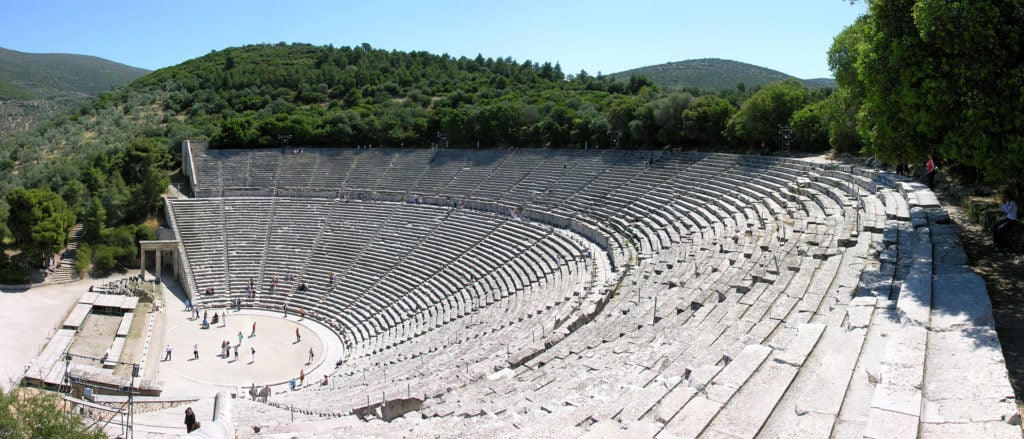
The Theater at Epidaurus. Credit: Hansueli Krapf /Wikimedia Commons/CC BY-SA 3.0

The ancient mystery of the great sound quality at the ancient Greek theater of Epidaurus has finally been solved, researchers posit in a recent study.

Scientists have been wondering about the high sound quality of Epidaurus’ theater for decades, developing certain theories along the way.

The ancient theater of Epidaurus was designed by Polykleitos in the 4th century BC. The original 34 rows were extended in Roman times by another 21 rows. It seats up to 14,000 people.

The theater is admired for its exceptional acoustics, which permit almost perfect intelligibility of un-amplified spoken words from the proscenium to all 14,000 spectators, regardless of their seating.

Some even claim that audiences are able to hear a pin drop, or a match being struck, from any seat in the house.

Many have proposed theories regarding sound at theater of Epidaurus

Over the years, several theories were developed in order to explain the phenomenon, both by academics and amateurs.

Some of these theories suggest that prevailing winds carried sounds, or that masks amplified voices.

Researchers at the Georgia Institute of Technology have discovered that the limestone material of the seats provide a filtering effect, suppressing low frequencies of voices — thus minimizing background crowd noise.

Further, the rows of limestone seats reflect high-frequencies back towards the audience, enhancing the effect, noted Live Science.

“When I first tackled this problem, I thought that the effect of the splendid acoustics was due to surface waves climbing the theater with almost no damping. While the voices of the performers were being carried, I didn’t anticipate that the low frequencies of speech were also filtered out to some extent,” said mechanical engineer Nico Declercq.

It is astonishing, however, that the Greek builders of the theater probably did not understand the principles that led to the exceptional audibility of sound from the stage.

Others dispute quality of acoustics at Epidaurus

The Guardian newspaper reports that research conducted by Constant Hak, the assistant professor at the Eindhoven University of Technology, and his team, suggests such assertions are little more than Greek myth.

In a series of conference papers, which also involved experiments at the Odeon of Herodes Atticus and the theatre of Argos, Hak and his colleagues describe how they tested the claims.

They used 20 microphones, placing each one at 12 different locations around the theater of Epidaurus, together with two loudspeakers, one at the center of the “stage” – or orchestra – and one to the side.

Both speakers played, with a slight delay between them, a sound that swept from low to high frequency, with the speakers in five different orientations. In total, they made approximately 2,400 recordings.

The team then used the data to calculate sound strength at different points in the theater.
They then made a series of laboratory recordings of sounds, including a coin being dropped, paper tearing and a person whispering, and played them to participants, who adjusted the loudness of the sounds until they could hear them over background noise.

The results were then fed into the team’s calculations to reveal how far from the orchestra the different sounds would be heard.

While the sound of a coin being dropped or paper being torn would be noticeable across the whole theater, it could only recognizably be heard as a coin or paper halfway up the seating.

For a match striking, the situation was worse, while a whisper would only be intelligible to those in the front seats.

Further work, based on the loudspeakers playing voices, revealed that only when actors spoke out loudly would their words be intelligible in the seats furthest from the orchestra.

These findings have been challenged by a group of Greek scientists who argue that the methods used were not scientific.

Comments

Popular Posts

Μπέος: «Εύστοχα χαρακτηρίστηκε φτύσιμο στα μούτρα των μελών της ΕΕΑ»

Καρφιά προς την Επιτροπή Επαγγελματικού Αθλητισμού έριξε με δήλωσή του στα social media ο Αχιλλέας Μπέος. Με αφορμή την απόφαση του CAS για την υπόθεση ΠΑΟΚ-Ξάνθης, ο δήμαρχος Βόλου θυμήθηκε τις ενέργειες της επιτροπής στην περίπτωση του Ολυμπιακού Βόλου το 2011 όταν εκείνος ήταν ο ισχυρός άνδρας της ομάδας. Επίσης εξέφρασε την απορία του για το ότι κανείς μέχρι σήμερα δεν έχει υποβάλλει την παραίτησή του. Αναλυτικά όσα έγραψε ο Αχιλλέας Μπέος: «Η απόφαση του Διεθνούς Αθλητικού Δικαστηρίου (CAS) για την υπόθεση των ΠΑΟΚ–Ξάνθης, αναμφίβολα είναι ένα ηχηρό χαστούκι γι αυτό που στην Ελλάδα ονομάζουμε Επιτροπή Επαγγελματικού Αθλητισμού, που υποτίθεται αξιολογεί, κρίνει και αποφασίζει αντικειμενικά και με βάση το ισχύον Δίκαιο και στην πραγματικότητα αποδεικνύεται ένα εργαλείο άσκησης μικροπολιτικής και ικανοποίησης αθέμιτων επιθυμιών και επιδ...

The Fascinating History of Thessaloniki’s Iconic White Tower

The White Tower. Credit: ΣΟΛΑΚΙΔΗΣ ΣΩΤΗΡΙΟΣ /Wikimedia Commons/ CC BY-SA 4.0 Residents of Thessaloniki, Greece’s second largest city, often use its White Tower as a point of reference when giving directions in the beautiful seaside city. That’s because the tower is by far Thessaloniki’s most iconic monument. The ancient city, located in northern Greece, has a rich history stretching from antiquity to the modern era, but is most noted for its importance during the Byzantine period. During that time, Thessaloniki was a competitor with the great city of Constantinople in terms of its wealth and influence. The White Tower was a witness to many of the city’s most important historical events, and its role in Thessaloniki changed as did the ownership of the city itself throughout the millennia. Studying the history of the White Tower means learning the history of Thessaloniki. The Tower’s strategic location along the Thermaic Gulf made it perfect for guarding the city from thre...

Inside the Magnificent Minoan Palace of Knossos in Crete

The Minoan palace at Knossos. Credit: Gary Bembridge /Wikimedia Commons/ CC-BY-2.0 The Palace of Knossos, located about five kilometers (three miles) south of Heraklion on Kephala hill, was the largest of all the Minoan palaces in Crete. It was also at the core of the highly sophisticated civilization that flourished on the island over 3,500 years ago. The discovery of the Minoan Palace of Knossos The discovery and subsequent excavation of the palace dates back to the beginning of the twentieth century. Before then, Knossos had only served as a place mentioned in Greek mythology. The first modern scholar to take a serious interest in the area was the German Heinrich Schliemann, who in 1870 had excavated the site believed to be Troy. Schliemann was certain that a major Minoan palace lay hidden near Heraklion, but the Ottoman authorities who still ruled the island at the time denied any permission to dig there. Years afterward, the British archaeologist Arthur Evans, inspired b...

Ten Unforgettable Things to Do Around Syntagma Square in Athens

  Syntagma Square, Athens. Credit: Public Domain Syntagma Square has literally been the very heart of Athens ever since the city became the capital of the modern Greek state. With the Greek Parliament building and the Tomb of the Unknown Soldier looming over it, it is rich with history and is the place where most major events of the last two centuries have taken place. Its name in Greek means “Constitution Square,” a name granted by Greece’s first modern royal, King Otto, on September 3, 1843, after an uprising of the people. This was a smart political move, since the royal palace overlooked the square. In 1934, the royal palace was turned over to the Greek Parliament, and ever since that time, Syntagma Square has been the place where all public protests and demonstrations have taken place. Syntagma Square home to historic demonstrations and protests In December of 1944, just after the departure of the occupying Nazi troops, a people’s rally at the square was marred b...

Άποψη ΚΥΡ


Άποψη Κ Μητρόπουλου

 Άποψη

Θεσσαλονίκη: Εκατοντάδες μερίδες φαγητού σε αστέγους από τοπική επιχείρηση εστίασης

Στη Θεσσαλονίκη, μια επιχείρηση εστίασης αποδεικνύει εμπράκτως τι σημαίνει ευαισθησία και κοινωνική ευθύνη. Πρόκειται για το εστιατόριο του Στέφανου Σαράτση που έχει αρχίσει αυτή την προσπάθεια τους τελευταίους δύσκολους μήνες. Συμπαραστάτες του γνωστοί και άγνωστοι πολίτες που βοηθούν όσο μπορούν.
  Ξέφυγαν εντελώς οι Τούρκοι απόστρατοι -Ονειρεύονται απόβαση σε ελληνικά νησιά Ο ναύαρχος ε.α. του τουρκικού Ναυτικού Τζιχάτ Γιαϊτζί, γνωστότερος ως εμπνευστής του παράνομου τουρκολιβυκού μνημονίου για την ΑΟΖ, δήλωσε, ότι χάρη στην συμφωνία αυτή η Λιβύη πήρε τέσσερα νησιά από την Ελλάδα και δεκάδες τ.χλμ. θαλάσσιων εκτάσεων, χωρίς όμως να αναφέρει ποια νησιά ήταν αυτά που αποκάλεσε μεν ελληνικά, αλλά τώρα είναι… λιβυκά! Ο Γιαϊτζί, γνωστός «μαϊντανός» των τουρκικών ΜΜΕ «εξήγησε», κατά τη διάρκεια συνέντευξής του στο κανάλι Al-Jazeera Mubasher, ότι «αυτή η συμφωνία παρείχε στη Λιβύη "39 χιλιάδες χιλιόμετρα υδάτινης επιφάνειας, μαζί με 4 ελληνικά νησιά"», προσθέτοντας ότι «εάν η Λιβύη είχε υπογράψει τη συμφωνία...

Άποψη


Άποψη ΚΥΡ


Airline Training Center

Car 'n Motion

Αthletix.gr

Φόρμα επικοινωνίας

Name

Email *

Message *