


Among the many heroes of the Greek War of Independence, Georgios Dimitrios Dikaios, better known by the nickname “Papaflessas,” was perhaps the most controversial personality.
Papaflessas was not only a clergyman but a brave warrior with a magnetic personality with incredible leadership skills. He was one of the very first to raise his rifle and shout “Liberty or Death.”
A leading member of Filiki Eteria, Panagiotis Sekeris had described him as “impetuous.” Papaflessas justified this at every opportunity
At the same time he was a womaniser and hard drinker who lived a life of debauchery, completely unfit for a man of the cloth.
He was also very irritable, belligerent and prone to create rivalries, even among his fellow fighters in the Greek War of independence.
For all these reasons, Papaflessas was personally hated by most of the rebelling Greeks, yet no one could deny that he was a devoted patriot who died for his homeland.
Grigorios Dikaios-Flessas and Filiki Eteria
Born Grigorios Dikaios in Messinia of Morias (today Peloponnese) in 1788, he was the son of Dimitrios Dikaios, a man who had fathered 28 children. “Flessas” was a nickname.
Historians say that the young man inherited his love for women from his father — and women loved him back.
In 1816 he became a monk in the monastery of Panagias tis Velanidias in Kalamata, where he took the name Grigorios Flessas, hence “Papaflessas” (priest Flessas).
Papaflessas soon clashed fiercely with a Turkish official over the monastery property and was forced to leave the area.
He moved to the island of Zakynthos, where he became Archimandrite, and from there he chose to move to Constantinople in 2018.
Once in Constantinople, he was initiated into the secret revolutionary society Filiki Eteria by Anagnostaras, who later became one of the great chieftains in the Greek War of Independence.
Papaflessas demanded to know who the leader of Filiki Eteria was and threatened to slaughter a member of the secret society unless he was told.
True to his character, he turned the house Filiki Eteria provided for him into a den of depravity, visited frequently by the police after neighbors’ complaints.
Yet his pure love for Greece and his devotion to the liberation cause allowed the Greeks of Constantinople to forgive his debauched lifestyle.
Using any means to start the War of Independence, he presented to Filiki Eteria forged documents showing that the Morias was ready to declare war against the Ottomans.
Yet Spyridon Papadopoulos Korfinos rebutted him, saying that he had been to Morias seven months ago and the situation there did not reflect Papaflessas’ claims.
A fierce fighter
Papaflessas returned to Greece to get involved in on-the-ground fighting as part of the Greek War of Independence.
In January 1821, he met with the leadership of Morias in Vostitsa and followed exactly the same strategy to persuade them to take part in the revolution.
That is, he lied — saying that Alexandros Ypsilantis was ready to campaign against Constantinople with the Russian fleet and the “blessings” of the Tsar.
No one believed his exaggerated claims, which Andreas Zaimis described as “unstable, desperate, rebellious, selfish and almost barbaric.”
Using intrigue and outrageous plots, Papaflessas travelled all over Morias, using his priesthood to convince people to start the rebellion.
Because of his sincere love for his country, he managed to enlist a sizable number of people to form an army of devoted soldiers.
Papaflessas and his men fought in many battles in Morias, stopping the army of Omer Vrioni in Corinth and Argolis until the end of 1821.
In 1822, along with Theodoros Kolokotronis, Papaflessas fought the mighty army of Dramali Mahmud Pasha who came from Larissa to suppress the revolution in Morias.
In July, along with Generals Kolokotronis, Demetrios Ypsilantis and Nikitaras and their armies, they thrashed Dramali’s army in the Dervenakia pass.
Politics — and a glorious death in battle
In December 1822, the Greeks finally took the city of Nafplion and made it their provisional capital. However, factional conflicts broke out bringing the first civil war (1823-1825).
The end of the civil war found Papaflessas on the victors’ side, when the chieftains were put in prison, including Kolokotronis, who was jailed in Nafplion.
In February 1825, Ibrahim Pasha and his massive army left Egypt and landed in Morias, determined to put an end to the Greek revolution once and for all.
Papaflessas realized the imminent danger and demanded the release of the chieftains in order that they might face the impending threat together.
His demand provoked understandable reactions, since he had actively participated in their arrest. The chieftains were not released and Papaflessas took matters into his own hands.
He promised that when he returned, he would release them and started for Maniaki with 1,000 men, while Ibrahim’s army numbered 6,000.
Papaflessas hoped that aid would arrive soon to make his army a match for Ibrahim’s troops. It never did.
When the Greeks saw the Ottoman Army lined up in battle position, they were terrified and many fled. Papaflessas was left with 600 men — other sources claim as few as 300.
Nevertheless, the stubborn Papaflessas, who had once been a monk, remained steadfast in his position, although he was neither a chieftain, nor a trained soldier.
The battle began on May 20, 1825 and within a few hours, the Greek forces had been decimated. Papaflessas fell alongside his men.
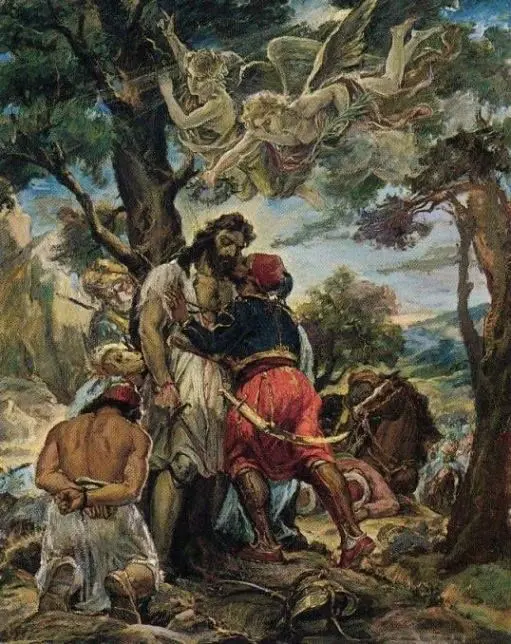
According to lore, impressed by Papaflessas’ bravery, Ibrahim asked his men to search for the body of the gallant Greek.
The soldiers found Papaflessas’ decapitated body and brought it to him, but Ibrahim told them to find his head as well and bring it to him.
Once the head was brought to the Pasha, he asked his men to attach it to the body and fasten it to a tree. He then proceeded to kiss Papaflessas’ face, as a gesture of respect.
Comments
Post a Comment