Ancient Greek Helmet Found in Burial Chamber in Croatia


Greek Helmet
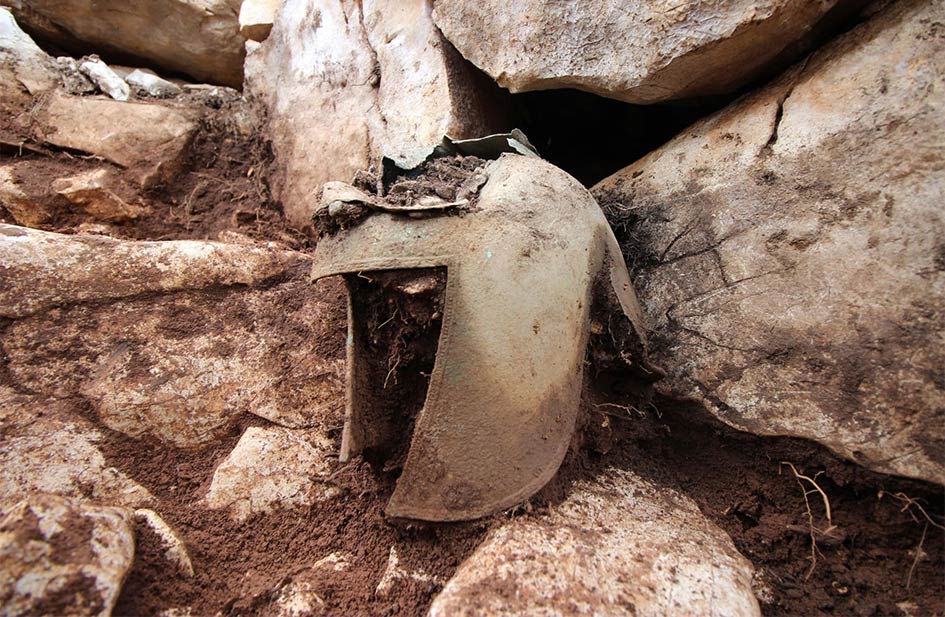
The Greek-Illyrian war helmet found in southern Dalmatia, Croatia in December of 2020. Credit: Dubrovnik Museums

A very rare bronze Greek-Illyrian war helmet, used in Greece during the time of the Greco-Persian Wars, was recently discovered in a rock-cut tomb in Dalmatia, Croatia.

The form of the iconic open-faced helmet, which archaeologists consider an especially rare find, originated in the Peloponnese during the 8th and 7th centuries BC.

The spectacular find was made recently during the exploration of the cave tomb in Zakotarac, located on the Pelješac peninsula, in southern Dalmatia, Croatia. The tomb was for a Greek warrior buried approximately three centuries later, however, in the 4th century BC.

The rare find, accompanied by many other valuable objects from the era, was discovered within a previously-unknown rock-cut tomb along a hillside near Gradina.

The iconic helmet of the greek warriors

This particular style of helmet, which became the iconic head covering of Greek warriors over the centuries, was first used by the Etruscans and Scythians. It later became known as the Illyrian helmet.

An alternate form of this helmet was also developed in Italy, according to archaeologists who gleaned this information from depictions on ivory relief sculptures. However, this style of helmet became obsolete in most areas of Greece in the early 5th century BC and its common use in Illyria ended by the 4th century BC.

Part of the warrior’s skull appears to be visible from the openings of the helmet, although earth has over the millennia made its way into where the rest of his head would be.

Adding to the importance of the find, archaeologists also discovered a treasure trove of ancient weapons, including spears and knives, in the same Croatian grave.

At least two other people had been buried along with the warrior, including a woman, who was found wearing a bronze bracelet.

According to a report in Archaeology News Network, additional treasures at the gravesite included “fifteen bronze and silver fibulae (clasps), twelve needles, several spiral bronze ornaments and tweezers and several hundred glass paste and amber beads belonging to necklaces.”

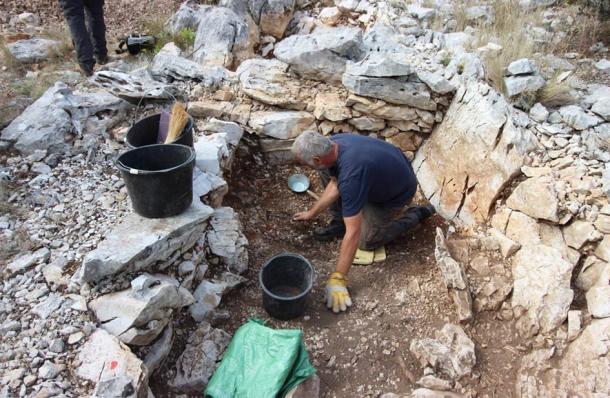
The spectacular find was made when archaeologists were working on restoring a damaged burial mound. The rectangular space of the mound measured approximately 3 x 2 meters (9.84 x 6.56 feet).

The body of the warrior had been laid to rest in a west-east direction in the tomb, but unfortunately, his bones were found in a “rather poor condition,” according to the archaeologists.

The tomb dates back to earlier than the nearby colony on Korčula, which is known to have been founded in the late 4th or early 3rd century BC, according to the project coordinator, Dr. Hrvoje Potrebica, from the Department of Archaeology of Zagreb University.

The discovery was made possible after last year’s visit to western Peljesac by a team from Croatia’s Center for Prehistoric Research. In the process of exploring this area, they were able to identify potential archaeological dig sites at the Illyrian Cave Sanctuary at Nakovana, dating back to the 4th to 1st centuries BC.

Priceless objects to accompany the dead in the afterlife

During this reconnaissance, they found grave goods deposited around a stalagmite. Professor Potrebica holds that the fourth century BC Greek-Illyrian helmet “is exceptionally rare” and is one of only about forty such helmets that have ever been found in all of Europe.
Archaeologists working in Croatia
Archaeologists working at the grave site in Croatia. Credit: Dubrovnik Museums

Another treasure found in the grave were thirty vases of predominantly Greek origin — although the researchers believe that they had been made by both Attic and Italian workshops.

According to the archeologists, these types of vessels were among the most expensive vases made during that period. Along with these rare discoveries, the researchers were able to pinpoint many other previously unknown sites in Nakovana, Professor Potrebica stated.

The researchers additionally were able to examine another group of prehistoric mounds around the Croatian village of Zakotorac. Following a road that is believed to have been trodden in prehistoric times, they came upon yet another site known as “the Vidohovo spring.”

The archaeologists state that they believe this site will yield yet more treasures, possibly including a shrine, with Dr. Potrebica adding that it holds “enormous potential.”

In 2021, after all the pandemic-related restrictions will be lifted, the archeological team hopes that they will once again be able to return to this site, which will enable them to lace these finds into their proper historical context.

Dr. Potrebica told interviewers that the discovery of the bronze war helmet, along with the other “exceptional finds” on Korcula, are presenting archaeologists with a new understanding of the “importance of the southern Adriatic in the historical dynamics of this part of Europe.”

Comments

Popular Posts

Μπέος: «Εύστοχα χαρακτηρίστηκε φτύσιμο στα μούτρα των μελών της ΕΕΑ»

Καρφιά προς την Επιτροπή Επαγγελματικού Αθλητισμού έριξε με δήλωσή του στα social media ο Αχιλλέας Μπέος. Με αφορμή την απόφαση του CAS για την υπόθεση ΠΑΟΚ-Ξάνθης, ο δήμαρχος Βόλου θυμήθηκε τις ενέργειες της επιτροπής στην περίπτωση του Ολυμπιακού Βόλου το 2011 όταν εκείνος ήταν ο ισχυρός άνδρας της ομάδας. Επίσης εξέφρασε την απορία του για το ότι κανείς μέχρι σήμερα δεν έχει υποβάλλει την παραίτησή του. Αναλυτικά όσα έγραψε ο Αχιλλέας Μπέος: «Η απόφαση του Διεθνούς Αθλητικού Δικαστηρίου (CAS) για την υπόθεση των ΠΑΟΚ–Ξάνθης, αναμφίβολα είναι ένα ηχηρό χαστούκι γι αυτό που στην Ελλάδα ονομάζουμε Επιτροπή Επαγγελματικού Αθλητισμού, που υποτίθεται αξιολογεί, κρίνει και αποφασίζει αντικειμενικά και με βάση το ισχύον Δίκαιο και στην πραγματικότητα αποδεικνύεται ένα εργαλείο άσκησης μικροπολιτικής και ικανοποίησης αθέμιτων επιθυμιών και επιδ...

The Fascinating History of Thessaloniki’s Iconic White Tower

The White Tower. Credit: ΣΟΛΑΚΙΔΗΣ ΣΩΤΗΡΙΟΣ /Wikimedia Commons/ CC BY-SA 4.0 Residents of Thessaloniki, Greece’s second largest city, often use its White Tower as a point of reference when giving directions in the beautiful seaside city. That’s because the tower is by far Thessaloniki’s most iconic monument. The ancient city, located in northern Greece, has a rich history stretching from antiquity to the modern era, but is most noted for its importance during the Byzantine period. During that time, Thessaloniki was a competitor with the great city of Constantinople in terms of its wealth and influence. The White Tower was a witness to many of the city’s most important historical events, and its role in Thessaloniki changed as did the ownership of the city itself throughout the millennia. Studying the history of the White Tower means learning the history of Thessaloniki. The Tower’s strategic location along the Thermaic Gulf made it perfect for guarding the city from thre...

Inside the Magnificent Minoan Palace of Knossos in Crete

The Minoan palace at Knossos. Credit: Gary Bembridge /Wikimedia Commons/ CC-BY-2.0 The Palace of Knossos, located about five kilometers (three miles) south of Heraklion on Kephala hill, was the largest of all the Minoan palaces in Crete. It was also at the core of the highly sophisticated civilization that flourished on the island over 3,500 years ago. The discovery of the Minoan Palace of Knossos The discovery and subsequent excavation of the palace dates back to the beginning of the twentieth century. Before then, Knossos had only served as a place mentioned in Greek mythology. The first modern scholar to take a serious interest in the area was the German Heinrich Schliemann, who in 1870 had excavated the site believed to be Troy. Schliemann was certain that a major Minoan palace lay hidden near Heraklion, but the Ottoman authorities who still ruled the island at the time denied any permission to dig there. Years afterward, the British archaeologist Arthur Evans, inspired b...

Ten Unforgettable Things to Do Around Syntagma Square in Athens

  Syntagma Square, Athens. Credit: Public Domain Syntagma Square has literally been the very heart of Athens ever since the city became the capital of the modern Greek state. With the Greek Parliament building and the Tomb of the Unknown Soldier looming over it, it is rich with history and is the place where most major events of the last two centuries have taken place. Its name in Greek means “Constitution Square,” a name granted by Greece’s first modern royal, King Otto, on September 3, 1843, after an uprising of the people. This was a smart political move, since the royal palace overlooked the square. In 1934, the royal palace was turned over to the Greek Parliament, and ever since that time, Syntagma Square has been the place where all public protests and demonstrations have taken place. Syntagma Square home to historic demonstrations and protests In December of 1944, just after the departure of the occupying Nazi troops, a people’s rally at the square was marred b...

The World’s Oldest Living Olive Tree is on Crete

The most ancient olive tree in the world, in Crete. Credit: Dimitra Damian/Greek Reporter The oldest olive tree in the world is located in the village of Ano Vouves of Kissamos in Chania, Crete. The ancient tree is 3000 years old, as determined by the international scientific community. The ancient olive tree in Vouves has a trunk with a circumference of 12.5 meters (41 feet), and a diameter of 4.6 meters (15 feet). It belongs to the local tree variety of tsounati, and was grafted at a height of 3 meters onto a wild olive tree. Because of the grafting, its trunk has been so beautifully shaped by nature that it resembles a sculpture. In 1990, after a unanimous decision in the prefecture of Chania, the Vouves Olive Tree was declared a Natural Monument of great importance due to its status as the world’s oldest tree of its kind. The oldest olive tree still produces high-quality olives The fruits of the ancient olive tree make the best olive oil in the world, making the area...

Θεσσαλονίκη: Εκατοντάδες μερίδες φαγητού σε αστέγους από τοπική επιχείρηση εστίασης

Στη Θεσσαλονίκη, μια επιχείρηση εστίασης αποδεικνύει εμπράκτως τι σημαίνει ευαισθησία και κοινωνική ευθύνη. Πρόκειται για το εστιατόριο του Στέφανου Σαράτση που έχει αρχίσει αυτή την προσπάθεια τους τελευταίους δύσκολους μήνες. Συμπαραστάτες του γνωστοί και άγνωστοι πολίτες που βοηθούν όσο μπορούν.

Rolls-Royce Names Panos Kakoullis New CFO

Rolls-Royce aircraft engine. Credit: Mark Kobayashi Hillary/ CC BY 2.0 British aircraft engine maker Rolls-Royce will name Panos Kakoullis as its new CFO, Reuters reported on Monday. Kakoullis will start in his new role on May 3. The company hopes that the Greek-British Kakoullis, former head of audit and assurance at Deloitte, will successfully guide the company through the coronavirus pandemic. As the the second-largest maker of aircraft engines, Rolls Royce has taken major hits due to the dramatic decrease in air travel caused by the coronavirus. Airlines pay the company by the number of hours each plane is in flight. Accordingly, as the travel industry has come to a standstill, Rolls Royce faced severe financial difficulty in the past year. Rolls Royce CEO Warren East highlighted Kakoullis’ over 30 years experience at Deloitte in a statement: “Panos delivered significant transformational change at Deloitte, streamlining and simplifying the business and we look forwa...

Άποψη


Άποψη


Άποψη ΚΥΡ


Airline Training Center

Car 'n Motion

Αthletix.gr

Φόρμα επικοινωνίας

Name

Email *

Message *